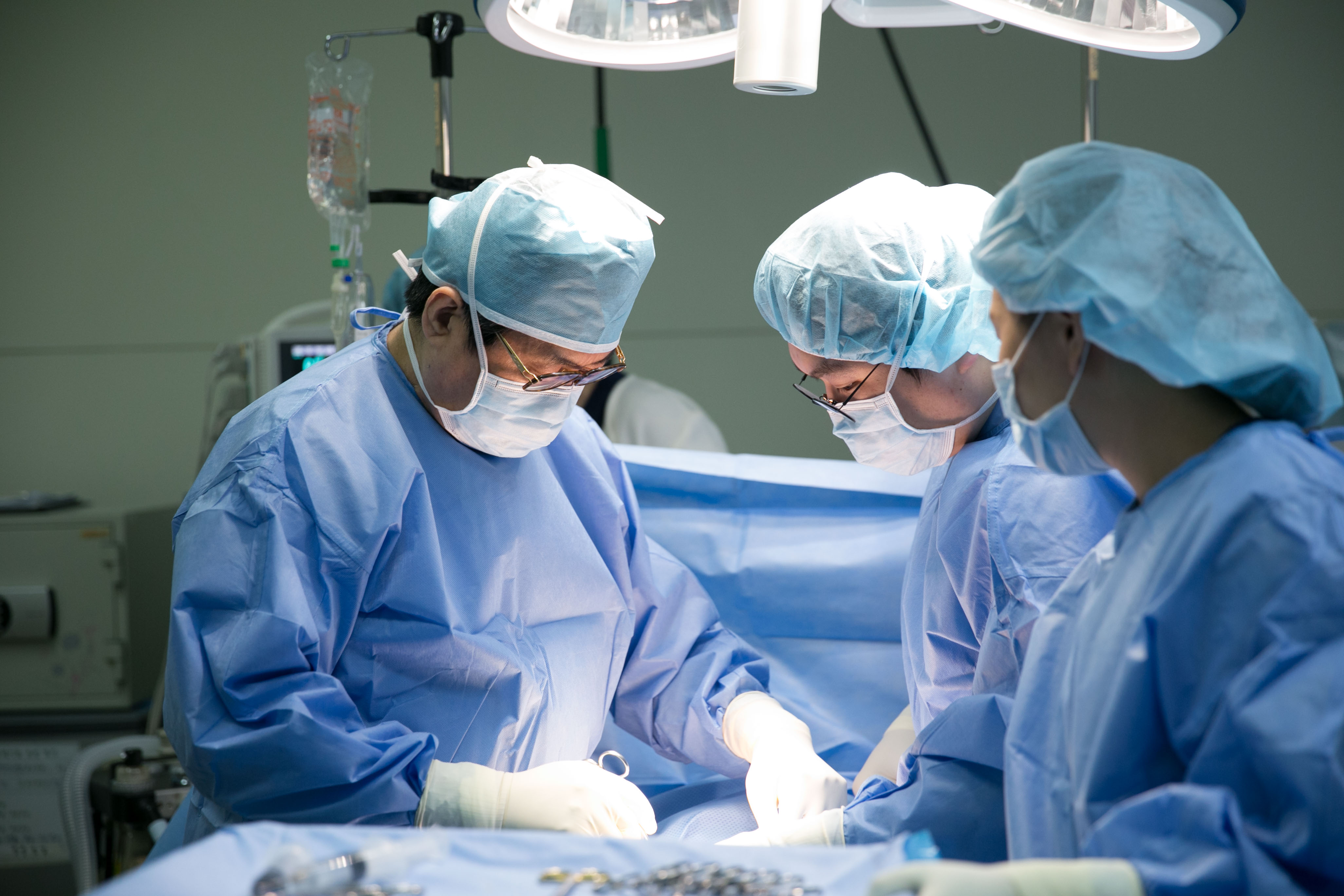
Duration
1 - 1.5 hours
The Mesh-Free Solution
The World's Most Advanced Mesh-Free Hernia Surgery
Chronic Pain Rate
<0.4%*
Cunningham 2
vs 10–20% with mesh
reoperation Rate
<0.49%*
vs 10–20% with mesh
Mesh-Free Surgeries
30,000+
incl. 20,000+ personally by Dr. Kang
*based on our internal registry of over 20,000 mesh-free repairs at Gibbeum Hospital as of end-2025
Kang Repair achieves what no other technique has achieved. The reoperation rate is less than 0.49%* — lower than mesh surgery (2–10%), lower than any mesh-free technique ever documented, and lower than any hernia repair technique in medical literature. The chronic pain rate is less than 0.4%*, which is 30 times lower than mesh surgery (10–20%), and even then, it is only mild.
Just a few permanent sutures — no mesh at all. Natural, anatomical healing.
<0.4%* Cunningham 2
Lower than mesh surgery
(2-10%)
0%
Sutures only
<0.49%*
Lower than mesh surgery
(2-10%)
This is not “the best mesh-free technique” — this is one of the most advanced hernia repair techniques available today as of the end of 2025
You've probably heard:
Traditional mesh-free methods failed with 10-30% recurrence rates. Surgeons believed this was due to “tension” from simple closure of the defect. But if tension were truly the cause, we should see 10%+ rupture or tear rates at suture sites in other abdominal surgeries too — which we don't. Even during this era, well-managed techniques such as Shouldice repair achieved recurrence rates below 5%.
One likely reason for the high failure rates: Many older techniques relied on stretched and weakened muscle tissue for repair. When you use stretched and weakened muscle to close a defect, the repair is more likely to fail. Tension may not have been the major cause; rather the choice of tissue may have mattered more.
Standard mesh surgery reduced recurrence — but at what cost? Recurrence still 2-10%. Plus 10-20% develop chronic pain. Permanent foreign material remains in your body forever.
Many surgeons continue with this approach because alternatives have been limited — until now.
A custom, anatomically precise reconstruction of your hernia — using only your own healthy tissue. Developed by Dr. Kang over 20,000+ mesh-free surgeries, refined year after year, proven in patients from 57 countries.
Your hernia is unique. Indirect inguinal hernia ≠ Direct inguinal hernia ≠ Femoral hernia.
• Standard mesh surgery: Uses mesh in every case, but largely treats all types with similar, generic patches that only slightly vary in material or shape.
• Kang Repair: Precisely defines your specific defect and applies a tailored, mesh-free reconstruction technique optimized for that hernia type.
• Many older mesh-free techniques failed because they relied on damaged, weakened muscle. Kang Repair uses strong, healthy muscle, intact fascia and ligaments, and natural anatomical structures.
• Result: Tension-balanced, durable reconstruction designed to last — without artificial reinforcement.
• Some chronic pain after hernia surgery results from nerve injury. Kang Repair protects: ilioinguinal nerve, iliohypogastric nerve, genital branch of genitofemoral nerve, vas deferens, testicular vessels, and cremaster muscle.
• This is why Kang Repair has <0.4% chronic pain rate — compared to 10-20% with mesh surgery
(Not one-size-fits-all)
Your problem: Defective shutter mechanism — Hernia sac pushing through internal inguinal ring — Dilated internal ring
Our solution: Reduce or remove hernia sac completely — Reconstruct the conjoined arch and reinforce the shutter mechanism over internal ring (tension-controlled) — Protect vas deferens, vessels, nerves, and cremaster muscle throughout
Result: Durable stability with natural anatomy reinforced — Shutter mechanism reconstructed to function more effectively — No mesh needed
Key innovation — The Quatro Fix: Unlike generic repairs that only reinforce Hesselbach triangle to indirectly narrow the ring, Kang Repair applies four simultaneous protection mechanisms for indirect inguinal hernia:
Directly narrows the dilated internal ring, addressing the root cause immediately.
Lowers the shutter further to cover the upper part of Hesselbach triangle, significantly helping to reduce the risk of future direct hernia formation.
Transforms the dilated 2D ring into a narrow, long 3D tunnel, creating a complex physical barrier against recurrence.
Uses your own physiology: Muscle contraction actively further narrows the tunnel whenever you cough or strain.
Your problem: The Hesselbach triangle — a specific area of the posterior wall composed of transversalis fascia — has weakened, allowing tissue to bulge through
Our solution: Reduce direct sac, reconstruct Hesselbach triangle using strong healthy muscle and ligament instead of stretched and weakened overlying fascia and muscle. During this process, we also identify and address any hidden indirect sac to minimize the possibility of future indirect hernia development.
Key innovation: We don't just “patch” the weakness or mindlessly use only the muscles that are visible to the eye — we rebuild the entire Hesselbach triangle by deliberately using your body's strongest and most robust muscles.
We don't stop at fixing your current hernia. Mesh repair addresses this by placing a large mesh to cover the entire groin area — but this comes with the downsides of permanent foreign material. With minimal but highly effective additional steps, we achieve similar protection without mesh:
This comprehensive approach means it is uncommon for patients to return with a different type of hernia on the same side.
| Outcome | Kang Repair | Mesh Surgery |
|---|---|---|
| 2-Year reoperation Rate | <0.49%* | 2-10% |
| Chronic Pain/Complications | <0.4%* | 10-20% |
| Foreign Material | Only sutures | Permanent mesh |
| Early Post-Op Pain | Lowest | Moderate-high |
*Internal registry of Gibbeum Hospital as of end-2025
“Isn't Kang Repair just a variation of Marcy Repair?”
This question reflects a fundamental misunderstanding. Classical repairs such as Bassini, Shouldice, and Marcy share the same essential approach. They elevate the spermatic cord, divide the cremaster muscle, and repair the transversalis fascia. The primary difference among them lies in the extent or location of repair, whether at the Hesselbach triangle or the internal inguinal ring area.
Kang Repair for indirect inguinal hernia is fundamentally different. It does not elevate the spermatic cord and never divides the cremaster muscle. Instead of focusing on the transversalis fascia, it targets the conjoined arch and applies four simultaneous protection mechanisms.
For direct hernias, Kang Repair reconstructs the Hesselbach triangle using healthy rectus muscle, an approach not offered by Marcy repair.
“I had Desarda repair on my left side last year, then Kang Repair on my right side recently. The difference was night and day. Desarda: 9/10 pain. Kang Repair: 2/10 — walked comfortably the next day.”
Kang Repair aims not only for the lowest recurrence rate but also for the least painful surgery.
Your problem: Hernia through femoral canal (below inguinal ligament), high-risk area near major vessels.
Our solution: Infrainguinal approach (through the groin from below), meticulous protection of femoral vessels, close femoral ring securely, rebuild ligament framework. Some surgeons insist that femoral hernia must be repaired with mesh, but we actually repair femoral hernia using the simplest non-mesh technique very successfully.
Key innovation: Traditional femoral hernia repair has been performed using more complex methods than standard inguinal hernia surgery, whereas our infrainguinal approach is much simpler yet allows safer defect closure with less tissue trauma. As a result, patients who undergo femoral hernia repair experience significantly less pain than those undergoing inguinal hernia repair.
Outcomes: The reoperation rate for femoral hernia repair using the Kang technique is comparable to that of inguinal hernia repair — less than 0.49% as of end-2025.
Your problem: Weakness in the abdominal wall at or around the umbilicus (belly button) or along the midline of the upper abdomen has resulted in a defect (hole) in the fascia, allowing tissue to bulge through.
Our solution: At Gibbeum Hospital, we perform open tissue repair without mesh for umbilical and epigastric hernias with defects up to 5 cm in diameter.
Anesthesia considerations: Defects smaller than 3 cm: Local anesthesia with sedation — Defects 4 cm or larger: General anesthesia may be required
Key innovation: While many surgeons believe mesh is mandatory for umbilical and epigastric hernias, we achieve durable repairs using tissue-based techniques for appropriately sized defects — avoiding the long-term complications associated with mesh.
• Return to any activity that feels comfortable.
• If it feels acceptable, you may continue, including all forms of exercise.
• If discomfort occurs, pause and allow additional recovery time.
This is very different from mesh surgery, where surgeons often restrict activity for 4-6 weeks because foreign material needs time to “integrate” and risks mesh displacement.
“I was back at the gym at Day 12. Started light, but by Week 3 I was doing everything — squats, deadlifts, the works. No pain, no issues.”
*based on our internal registry of over 20,000 mesh-free repairs at Gibbeum Hospital
If you're reading this, you probably know these sentences too well: "Your scan looks normal." "The mesh is in the right position." "There's nothing we can do." "You'll just have to live with it." "The pain is in your head."
But you know something is wrong. You feel it every day: burning, pulling, stabbing pain; pain during sex or physical activity; inability to sit, walk, or exercise without discomfort; foreign-body sensation that won't go away.
You're not imagining it — your symptoms are real, and the mesh may be the problem.
Here's what typically happens in most countries:
You get hernia surgery. Mesh is inserted.
Pain persists for several weeks or longer. Your doctor says it's normal — it'll go away.
Months later, the pain persists or worsens. Your doctor says scans are normal — the mesh looks fine.
Eventually, you find a specialist willing to remove the mesh. But they remove the old mesh… and insert new mesh.
The result? If the mesh was causing your pain, replacing it with new mesh doesn't solve the problem — it restarts the cycle. Pain may persist, return, or new complications may develop.
We are one of the only centers worldwide that offers complete mesh removal (even embedded, scarred, or contracted mesh), true mesh-free reconstruction using the most effective and durable Kang Repair technique, and a guarantee that no new mesh will ever be inserted. This combination results in a near-zero recurrence rate — far better than mesh-to-mesh repairs.
This approach is very rare globally, which is why patients from the USA, Europe, Japan, China, and the Middle East fly to Korea for treatment.
Mesh is a permanent foreign material inside your body. Even when labeled “biocompatible,” mesh can cause significant issues because your body may treat it as an invader.
Common complications affect 10-15% of patients and include chronic pain, nerve entrapment, foreign-body sensation, mesh contraction, and pain during movement.
Serious complications affect 1-5% of patients and include infection, mesh migration, adhesions to intestines, bladder, or vessels, mesh erosion, and perforation.
If you're experiencing mesh complications, removal is often the only definitive solution.
Typical Hospital
Gibbeum General Hospital
Kang Repair Hernia Center
*based on our internal registry of over 20,000 mesh-free repairs at Gibbeum Hospital as of end-2025.
In most cases, yes. We have successfully removed embedded mesh (stuck to surrounding tissue), scarred or contracted mesh, mesh from multiple previous surgeries, partially eroded or infected mesh, and all major mesh types including polypropylene, polyester, composite, and biological mesh.
The surgery takes 1-1.5 hours depending on how embedded the mesh is and the complexity of the case.
Our approach involves careful dissection to remove as much mesh material as possible while striving to protect nerves and vessels and preserve healthy tissue. In most patients, we are able to remove nearly all of the mesh. The exception is rare cases where mesh is adhered to major blood vessels or other high-risk structures — in such situations, small remnants may be left to ensure safety. We then reconstruct using Kang Repair principles. Hospital stay is typically 1-2 nights.
1 - 1.5 hours
complete mesh removal

1 - 2 nights
Hospital stay 1-2 nights, light walking from Day 1
Resume light daily activities, desk work, most foreign-body sensation gone
Light exercise, many patients report significant pain improvement
Return to sports and heavy activity, full recovery
Important: Recovery after mesh removal can take longer than primary hernia repair because we're dealing with scar tissue. But most patients say the recovery is worth it to finally be free of mesh pain.
Most patients experience 70-100% pain reduction. The recurrence rate is near-zero after mesh-free reconstruction.
Why not always 100% improvement? Sometimes nerve damage from the original mesh surgery is permanent, and chronic pain can have multiple causes. However, removing the source of irritation offers the best chance for relief.
John
"Five years of chronic pain after mesh surgery. Three doctors told me nothing was wrong, that it was 'all in my head.' After mesh removal and Kang Repair — I'm finally pain-free. I have my life back."
Yuki
"No surgeon in Japan would attempt mesh removal — they said it was 'too risky.' Dr. Kang removed my mesh completely and reconstructed without new mesh. The foreign-body sensation disappeared immediately."
Contact us for a free consultation.
internationalcenter@gibbeum.com
WhatsApp: +82-10-9947-9530